The Waiting Room Worth the Wait: Six American Train Stations That Deserve a Half-Day
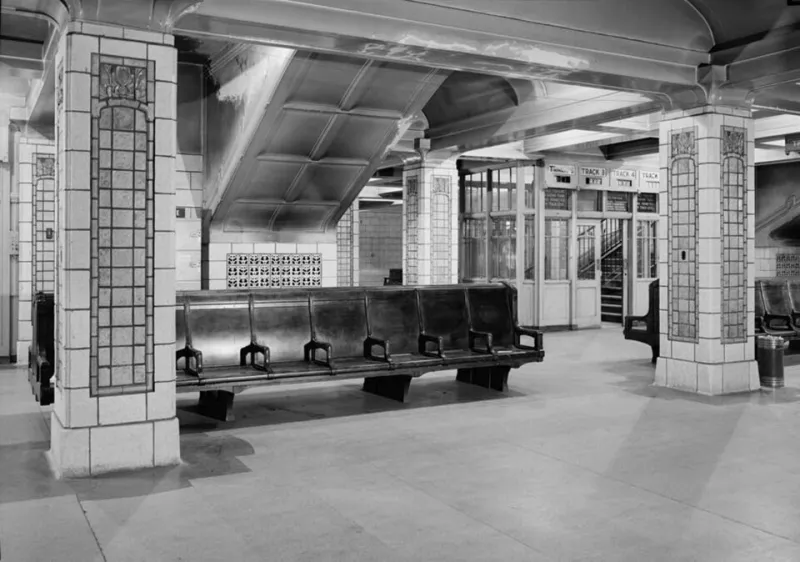
Photo: Jack Boucher, Public domain, via Wikimedia Commons
American train travel has a reputation problem: we treat the station as the annoying part before the good part. Which is a shame, because a handful of our terminals and depots are among the best free architecture this country has, and half of them are actively in use. The trick is arriving early on purpose — not to be safe, but to actually be there.
Six stations where the wait is the point.
Grand Central Terminal, New York
What to look for. The ceiling, first — the zodiac mural, painted in a way that's famously mirrored from the actual sky. Then the clock at the information booth (meet-under-the-clock is a real institution), the acoustic oddity of the whispering gallery outside the Oyster Bar, and the dining concourse downstairs, where the food is genuinely better than it needs to be.
When to go. Not 8 a.m. on a weekday. Not 5:30 p.m. either, unless you enjoy a very physical kind of tourism. Go early on a Sunday, or mid-evening, when the commuter tide has gone out and the hall actually echoes.
Build a half-day. Arrive ninety minutes before your train, wander the main concourse, eat something downstairs, then walk out onto 42nd Street and loop through Bryant Park before heading back. Set a phone alarm fifteen minutes before departure. Grand Central is not a place where you want to be sprinting.
Los Angeles Union Station
What to look for. The last of the great American terminals, opened in 1939, and a strange, gorgeous hybrid of Spanish Colonial, Mission Revival, and Art Deco. Look up in the main waiting room, then find the courtyards with the fountains — most people walk straight past them and never see the best part of the building.
When to go. A weekday morning. It's an active station, not a museum, and it feels best with a little life moving through it.
Build a half-day. Get there early, sit in the courtyard, then walk across the street to Olvera Street and El Pueblo, where the city's oldest surviving blocks sit in the shadow of a freeway. Lunch nearby, then back for your train. Budget twenty minutes for the walk alone; downtown is bigger than it looks on a map.
Kansas City Union Station
What to look for. The Grand Hall, a 95-foot-tall Beaux-Arts cathedral that was built in 1914 for a volume of passengers that never quite came back. There's a model railroad, a science center, and traveling exhibits in the old waiting areas. The building was very nearly lost in the 1980s and got saved by a city vote — science center funding came later, and you can feel the civic stubbornness in the walls.
When to go. Check what exhibit is running before you commit. A weekday afternoon is calm; weekends belong to families with strollers.
Build a half-day. Grand Hall first, then one museum — not three. Then walk up the hill to the National WWI Museum and Liberty Memorial for the view. Amtrak trains roll in again after decades away, so leave time to sit in the Hall and watch people arrive.
Cincinnati Museum Center at Union Station
What to look for. The rotunda. A 1933 Art Deco interior with a half-dome ceiling that photographs badly and feels enormous in person, ringed by mosaic murals of workers and machines. It's the kind of room that makes people stop talking without being asked.
When to go. Weekday mornings. The building holds three museums and a library, which means school groups — go early and stay ahead of them.
Build a half-day. Arrive early, walk the rotunda slowly, then pick exactly one museum and do it well. If your train runs three days a week (check the schedule, this is not the Northeast Corridor), take that seriously: the Cardinal is not a commuter line, and a missed departure means a very different trip.
Saint Paul Union Depot, Minnesota
What to look for. A 1923 neoclassical hall, restored and reopened in 2014 after decades of abandonment, with a Grand Waiting Room that's been returned to something close to its original dignity. Look for the ceiling details and the scale of the windows; the place was built for people who dressed up to travel.
When to go. A summer Saturday morning, when the Lowertown farmers' market sets up nearby. The hall is quiet then in the best way — a few travelers, a lot of coffee, no crowd.
Build a half-day. Market first, then the depot, then a walk through Lowertown's converted warehouses. The Empire Builder calls here, so there's a decent chance you'll see a long-distance train boarding, which is its own kind of theater.
Whitefish, Montana
What to look for. The small-town depot done right: a 1920s Great Northern building with a stone fireplace, wooden benches, and the general sense that the town built it as a point of civic pride and never stopped treating it that way. Glacier National Park starts essentially out the back door.
When to go. Summer, when the Empire Builder is busy and the light lasts until almost ten. Winter if you want the romance of snow and a train whistle.
Build a half-day. Downtown Whitefish is a short walk — coffee, a bookstore, a stroll. Then come back, sit by the fire, and wait for the train like people used to, which is to say: without doing anything else at the same time.
A few rules for lingering
Buy something — coffee, a sandwich, a magazine. Don't block a platform or a ticket window, and remember that Amtrak staff are working, not narrating. Keep an eye on the departure board even while you're admiring the architecture; gates change, and trains don't wait. Give yourself twenty minutes of buffer and set an alarm anyway.
Arriving early used to be a chore. In these buildings it's the first stop on the trip.