What You Bring Home Without Packing It: The Case for Intangible Souvenirs
Somewhere in America right now, there are approximately ten million refrigerator magnets that nobody looks at anymore. There are hand-woven baskets shoved under beds, decorative plates hung on walls out of obligation, and miniature Eiffel Towers that have migrated from the mantle to the junk drawer to the donation bin. We buy these things with the best intentions — we want proof, a physical anchor to a moment that felt too good to lose. But the anchor rarely holds.
What if we've been collecting the wrong things entirely?
The Problem With Proof
There's something deeply human about wanting to hold onto a good experience. You had a transcendent week in New Orleans, and you want to carry a piece of it home. So you buy the hot sauce, the jazz poster, the hand-painted mask. These feel like souvenirs in the truest sense — from the French souvenir, meaning "to remember." The object is supposed to do the remembering for you.
But objects are passive. They sit there. They don't remind you of anything unless you actively engage with them, and most of the time, you don't. The mask goes on the wall and becomes furniture. The hot sauce gets used once and sits behind the mustard. The memory fades anyway, because the object was never really the memory — it was just a placeholder for it.
The experiences you do with your hands and your mind and your body? Those don't fade the same way. They get wired in.
Skills Are Souvenirs That Compound
A few years ago, a traveler named Dana spent a week in Oaxaca. She came home with a small rug she bought at a market — nice enough, now in a guest bedroom — but also with something else: she'd spent an afternoon with a local weaver learning the basics of backstrap loom weaving. She wasn't good at it. She made about six inches of uneven fabric that the weaver's daughter thought was hilarious. But she understood something about the craft now, something embodied, and she's never looked at a woven textile the same way since.
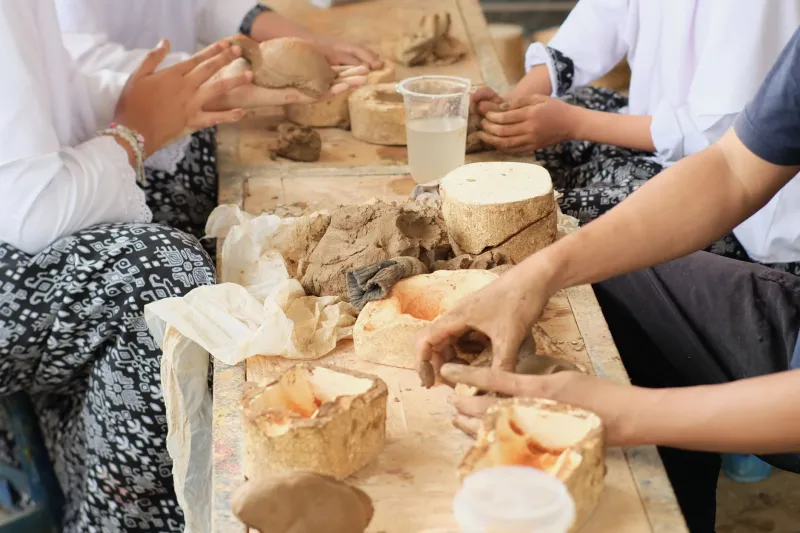
That's the thing about learning a skill on the road. It doesn't have to be mastery. It just has to be entry. You take a single knife skills class in a Tokyo cooking school and suddenly you're actually paying attention in every kitchen you walk into for the rest of your life. You spend one morning learning to throw clay at a studio in Asheville and you've permanently changed how you see pottery. The experience becomes a lens.
And here's the part nobody talks about: skills are souvenirs that compound. The pasta technique you picked up in Bologna gets better every time you use it. You teach it to your roommate. Your roommate makes it for a dinner party. The thing you brought home keeps giving.
Recipes as Time Machines
Food might be the most underrated vehicle for intangible souvenir-collecting, and it's one of the most accessible. You don't need to be a serious cook. You just need to be curious enough to ask.
Ask the woman running the breakfast spot in Cartagena how she makes her arepas de choclo. Ask the grandmother at the agriturismo in Tuscany what she actually puts in the soffritto. Ask the guy at the taco cart in Mexico City what cut of meat that is and how long it's been cooking. People love being asked about their food — genuinely love it — and more often than not, they'll tell you.
Write it down. Not in your notes app, where it'll get buried — write it on paper, or in a dedicated travel journal. Sketch the dish if you want. Note the smell of the market where you bought the ingredients. When you get home and try to recreate it, even imperfectly, you're not just making dinner. You're doing something closer to time travel.
Collecting Stories From Strangers
This one takes a little more nerve, but the payoff is enormous. Before you leave a place, try to document one person's story — not a famous person, not a tour guide giving a rehearsed speech, but an ordinary person whose life intersects with yours for twenty minutes.
The retired fisherman in a bar in Galicia who explains what the coast looked like before the tourists came. The elderly shopkeeper in Savannah who tells you about her family's history with the building she's worked in for forty years. The young chef in Portland (Oregon or Maine, take your pick) who quit a finance job to apprentice under a Thai cook and has never looked back. These are stories that don't exist in any guidebook, and they're yours if you're willing to sit still long enough to hear them.
You don't need to be a journalist. You just need to ask open-ended questions and then genuinely listen. "How long have you been here?" "What's changed the most?" "What do you wish people understood about this place?" Most people will surprise you. Some will floor you.
Write it down afterward. Or record a voice memo on the walk back to your hotel. The details are the thing — the specific way they described something, the phrase they used that you'd never heard before. That's the souvenir.
How to Actually Do This Intentionally
None of this has to be elaborate. You don't need to pre-book a week-long immersive cultural program (though those are great). You just need to shift your intention slightly before you travel.
Instead of asking "what should I buy here?" ask "what can I learn here?" Before you leave home, identify one thing you'd like to come back knowing how to do, cook, or understand. It doesn't have to be profound — it can be as simple as learning to play one song on a ukulele in Hawaii, or understanding how to identify a natural dye in a textile market in Guatemala.
Then, when you're on the ground, stay alert to the moments when someone offers to show you something. Those moments come up more often than you'd think. A shopkeeper who offers to demonstrate how a piece is made. A fellow traveler who invites you into a cooking session. A local guide who goes off-script to show you something personal. Say yes to those moments. They're the whole trip.
The Shelf Test
Here's a useful filter before you buy anything: Will this still matter to me in five years? Not "will I still have it" — of course you'll still have it, stuff is stubborn — but will it still carry meaning?
Now ask the same question about the afternoon you spent learning to make mole from scratch, or the conversation you had with a stranger about what home means to them. Those pass the test every time. They're not just memories. They're part of who you are now.
That's the souvenir worth collecting. It doesn't take up any space in your bag, and it never ends up in the junk drawer.