The Person You Didn't Plan to Meet: How Strangers Become the Best Guides You'll Ever Have
There's a version of travel that looks great on paper. You book the tours, you hit the highlights, you photograph the things you were told to photograph. And then you go home with a perfectly documented trip that somehow feels like it happened to someone else.
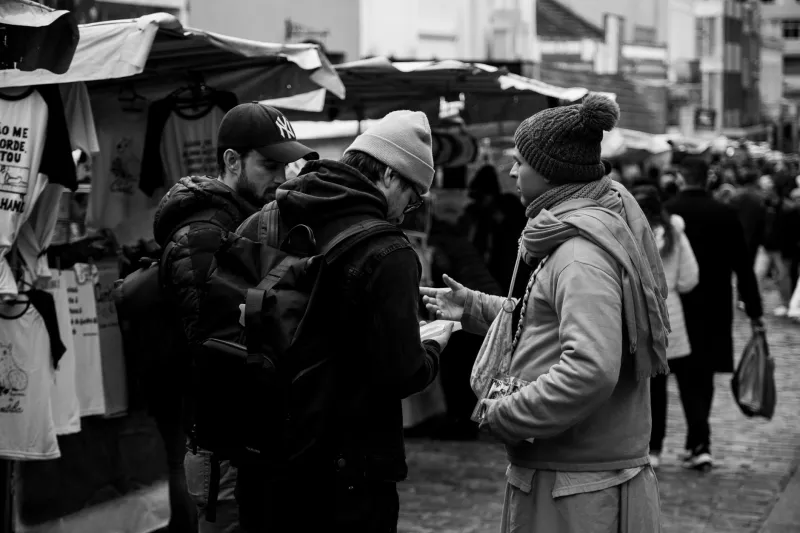
And then there's the other kind of trip — the one where a retired fisherman in Oaxaca sits down next to you at a market stall and, over the next two hours, dismantles everything you thought you knew about the place. Or where a fellow American you meet on a train platform in Portugal turns out to have spent six months in the exact region you're heading toward, and she hands you a hand-drawn map on a napkin that becomes the actual blueprint for your week.
Those people? They weren't in your itinerary. And they're the reason you still think about that trip years later.
Why Travel Loosens Us Up for Connection
There's real psychology behind why we tend to open up more when we're away from home. Researchers who study social behavior have long noted that unfamiliar environments lower our default defensiveness — we're already operating outside our routines, so we become more receptive to new input, including new people.
When you're a stranger somewhere, you're also temporarily freed from the roles you play at home. You're not the coworker, the parent, the neighbor. You're just a curious person in a new place. That anonymity is liberating in both directions — you're more willing to talk to strangers, and strangers are often more willing to talk to you.
Add in the fact that travelers tend to signal openness — you're sitting in a café with a notebook, wandering through a neighborhood market, lingering at a viewpoint — and you've essentially made yourself available in a way that everyday life rarely allows.
What Makes Someone an Unexpected Mentor
Not every interesting conversation turns into something that reshapes your trip. But some do, and it's worth thinking about what distinguishes a pleasant chat from a genuinely redirecting encounter.
The people who end up mattering most tend to share a few qualities. They're not performing for you — they're not trying to impress a tourist or sell you something. They're just living their lives and, for whatever reason, they let you into a corner of it. They often know something specific and deep: not a broad overview of a place, but an intimate understanding of one neighborhood, one craft, one way of doing things that no guidebook would think to include.
They also tend to ask you questions. The most memorable guides — planned or otherwise — are usually just as curious about you as you are about them. That mutual curiosity is what transforms a transaction into a relationship, even a brief one.
How to Put Yourself in the Path of These People
Here's the honest truth: you can't manufacture this. The moment you start approaching strangers with an agenda — I need this person to unlock the real version of this city for me — you've already killed the thing you're chasing. People can feel when they're being mined for authenticity.
What you can do is create the conditions.
Slow down more than feels comfortable. Most of us move through destinations at a pace that makes real conversation nearly impossible. Sitting in one place for two hours instead of thirty minutes changes everything. Order another coffee. Stay at the market stall longer than you need to.
Ask questions that aren't about tourism. Instead of asking where the best restaurant is, ask someone what they've been thinking about lately. Ask what's changed in their neighborhood in the past few years. Ask what they wish more visitors understood about where they live. These questions are unusual enough to be interesting, and they signal that you're not just collecting recommendations.
Follow the thread without demanding a destination. When someone mentions something offhand — a family tradition, a place they love, a story about the town — don't let it drop. That's the thread. Pull it gently. See where it goes.
Travel with a little empty space in your schedule. If every hour is spoken for, you literally cannot say yes when someone offers to show you something unexpected. Leave room for the unplanned.
Knowing When to Trust the Invitation
This is where American travelers, in particular, sometimes get tangled up. We're raised with a healthy skepticism of strangers, and that instinct isn't entirely wrong — especially when traveling solo or in unfamiliar regions. But that same instinct, left unchecked, can keep you at the surface of every place you visit.
Learning to read the difference between genuine generosity and a setup takes practice, but a few things help. Trust invitations that happen organically — that arise from a real conversation rather than an approach from a stranger who sought you out specifically. Notice whether the person seems interested in you as a human being or primarily in what you might spend. And lean on your gut: the feeling of authentic welcome is usually pretty distinct from the feeling of being worked.
When the invitation does feel genuine, say yes more often than feels natural. Go see the thing they want to show you. Meet the person they think you should meet. Eat the food they make at home instead of the restaurant they could just as easily recommend. That's where the trip lives.
The Relationships That Outlast the Journey
Some of these connections end when you leave the table. And that's fine — a two-hour conversation that fundamentally shifts how you see a place is complete in itself. You don't need to exchange Instagram handles for it to matter.
But some of them don't end. Travelers who make a habit of staying open to these encounters often find themselves with a loose, sprawling network of people around the world — not friends in the traditional sense, but something real nonetheless. People they email occasionally, people they look up when they return to a city, people whose names they mention for years when someone asks about a destination.
That's not a networking strategy. It's just what happens when you treat the people you meet while traveling as the point, rather than the backdrop.
The Guide You Didn't Hire
Carmelita Tours is built on the idea that the best travel experiences are curated — shaped with intention, designed to go deeper than the surface. And we stand behind that. A great guide, a well-planned itinerary, a thoughtfully chosen tour can unlock things you'd never find on your own.
But even the best-planned journey has gaps. And in those gaps — the unscheduled afternoon, the wrong turn that lands you somewhere unexpected, the seat next to a stranger on a slow regional bus — that's where the other kind of guide shows up.
You can't book them. You can't guarantee them. But you can make yourself the kind of traveler they want to talk to. And once you do, every trip gets a little less predictable and a whole lot more worth taking.